
AI Agents for SMEs: How to Choose the Workflows Worth Automating First
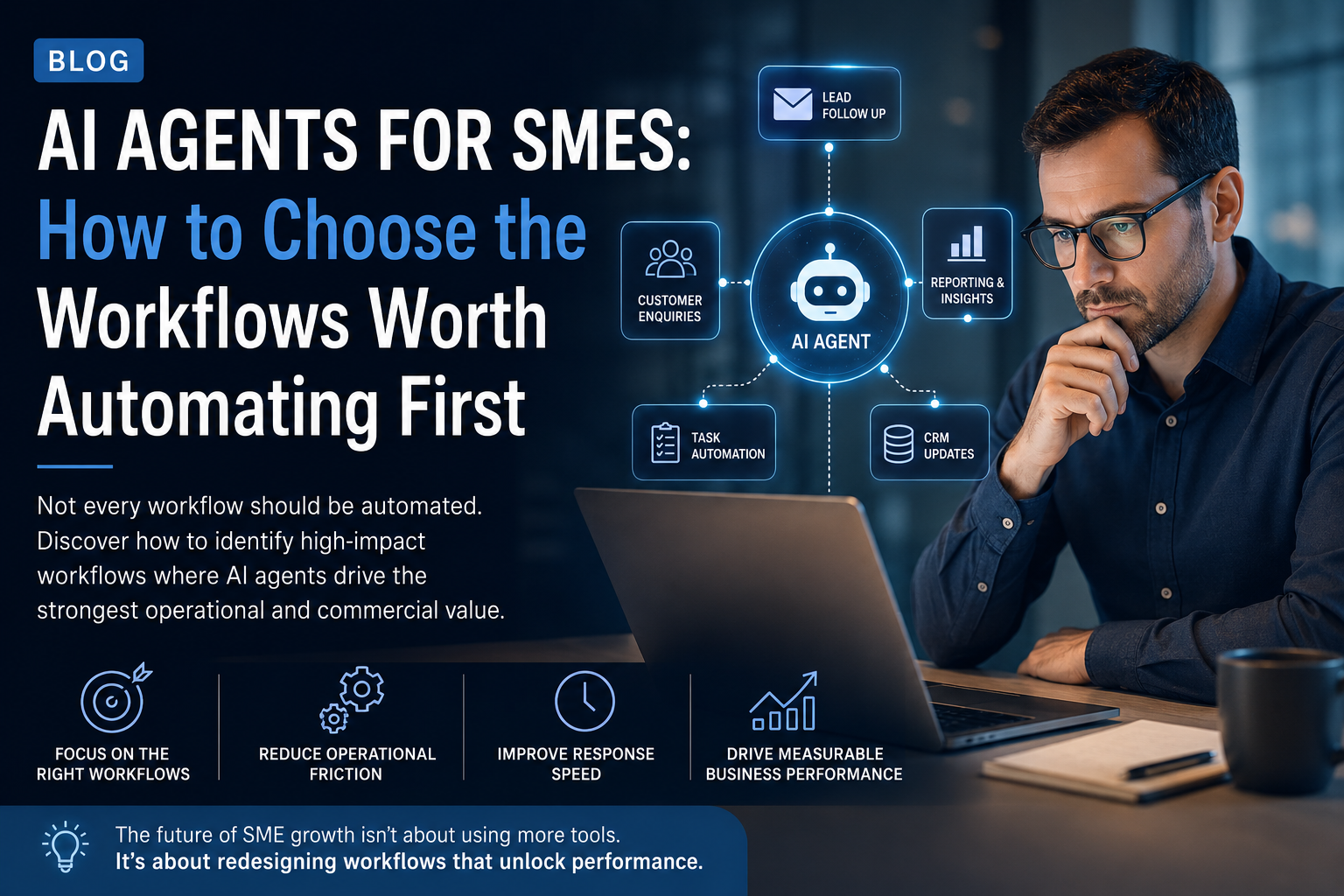
Artificial intelligence is rapidly moving beyond chatbots and content generation tools. Across the SME market, a new operational layer is emerging: AI agents and workflow automation systems capable of coordinating tasks, updating systems, responding to triggers, and supporting day to day business execution.
For many businesses, the opportunity is real. But so is the confusion.
Most SMEs are no longer asking whether they should explore AI. They are asking where AI agents and automation can create measurable operational and commercial value inside the business without adding more complexity.
This is where many AI projects begin to drift.
According to Gartner, more than 40% of agentic AI projects could be cancelled by 2027 due to escalating costs, weak business value, and inadequate risk controls. Reuters has also highlighted the growing issue of “agent washing”, where products are marketed as intelligent AI agents without delivering genuine operational value. Reuters
In practice, many SMEs are still approaching AI in a fragmented way. One team experiments with content generation. Another adds a chatbot. Someone automates a reporting task. A founder tries a few prompts. But very few businesses step back and ask a more commercially useful question:
Which workflows are actually worth redesigning first?
For SME founders, commercial leaders, operations managers, and scaling leadership teams, this is becoming one of the most important operational questions of the next few years. The businesses seeing the strongest gains from AI are often not the businesses using the most tools. They are the businesses identifying where operational friction, delays, repetitive coordination, and workflow bottlenecks already exist.
The Shift From AI Tools to AI Workflows
The market is beginning to shift from isolated AI tools towards AI enabled workflow systems. This shift is pushing many SMEs towards more structured human plus AI operating models rather than disconnected automation experiments.
This is an important distinction.
The real value of AI agents is not simply generating text or responding to questions. It is their ability to coordinate actions across workflows, systems, and operational processes.
Microsoft has described this shift as the transformation of “every workflow, every process” through AI agents embedded into business operations. Microsoft AI Workflow Transformation
Deloitte has similarly highlighted how agentic AI is moving towards orchestrated task execution and operational coordination across businesses. Deloitte Agentic AI Strategy
For SMEs, this changes the conversation significantly.
The opportunity is no longer simply:
“Which AI tool should we try?”
It becomes:
“Which operational bottlenecks, delays, or repetitive workflows are limiting performance today?”
That is a much more commercially useful question.
Why Many AI Automation Projects Fail
Many automation initiatives fail for a simple reason: businesses automate tasks before understanding the workflow around them.
In reality, poor processes rarely improve simply because automation is added on top.
If lead follow up is inconsistent, automating parts of the process without clarifying ownership and response logic can simply accelerate confusion. If reporting workflows are fragmented, introducing AI summaries without fixing the data flow underneath may create more noise rather than better decision making.
This is particularly relevant for SMEs, where workflows often evolve organically over time. Many businesses operate with:
founder dependent decision making
inconsistent lead handling
fragmented tools
manual handoffs
reactive communication
duplicated admin work
In practical SME environments, these workflow breakdowns often become visible long before businesses formally recognise them as operational problems. Delayed customer responses, inconsistent follow up, duplicated reporting, disconnected sales and marketing activity, and reactive coordination frequently create hidden performance drag across growing companies.
In those situations, automation should support operational clarity, not replace it.
The businesses currently seeing the strongest results from AI are often not the ones using the most tools. They are the ones identifying where operational friction already exists and redesigning those workflows intentionally.
What Makes a Workflow Suitable for AI Automation?
Not every workflow should be automated equally.
The strongest candidates for AI agents and workflow automation usually share several characteristics.
1. Repetitive Activity
Tasks repeated daily or weekly are often strong automation candidates. Examples include CRM updates, reporting, lead routing, customer responses, and internal coordination tasks.
2. Delays and Handoffs
Workflows involving multiple people, slow responses, or bottlenecks often create measurable inefficiencies. AI agents can help reduce delays by triggering actions automatically or coordinating information between systems.
3. Revenue Adjacent Processes
The highest ROI workflows are often linked directly to commercial performance. Lead handling, customer communication, proposal generation, and pipeline management are common examples.
4. Operational Fragmentation
Many SMEs operate across disconnected tools and spreadsheets. AI workflow systems can help bridge those operational gaps more effectively.
5. Structured Decision Logic
Processes with repeatable rules and predictable actions are typically easier to automate successfully than highly subjective or strategic work.
Where SMEs Often See Early AI ROI
In practical terms, some of the most common SME workflow opportunities include:
lead follow up and qualification
CRM administration
customer enquiry routing
reporting and dashboard summaries
content production coordination
internal operational updates
proposal preparation
recurring customer communication
sales and marketing handoffs
These are often not glamorous workflows, but they are operationally important.
The strongest automation opportunities are usually found where repetitive coordination and delayed execution already exist inside the business.
Where Human Judgement Still Matters
Despite the rapid development of AI agents, human judgement remains critical.
McKinsey has argued that the future of work is likely to be defined by partnerships between people, AI systems, and automation rather than complete replacement. McKinsey Agents, Robots and Us
For SMEs, this distinction matters.
AI can support:
workflow execution
coordination
summarisation
task automation
operational responsiveness
But humans still provide:
commercial judgement
prioritisation
relationship management
strategic direction
contextual decision making
The goal is rarely full automation. The goal is usually better operational leverage.
The Future SME Operating Model
Over the next few years, many SMEs are likely to evolve towards smaller operational teams supported by AI enabled workflows and intelligent automation systems.
This does not necessarily mean replacing teams entirely. More often, it means reducing repetitive coordination work, improving response speed, increasing operational consistency, and allowing smaller teams to operate more effectively.
The businesses that adapt best are unlikely to be those chasing every new AI tool. They will more likely be the businesses that:
understand their workflows clearly
identify operational friction honestly
prioritise high value automation opportunities
integrate AI agents carefully into existing operations
maintain human oversight where judgement matters most
The next phase of AI adoption for SMEs is unlikely to be defined by who uses the most tools. It will be defined by who redesigns workflows most effectively around the combined strengths of people and AI agents.
Frequently Asked Questions
What are AI agents for SMEs?
AI agents are software systems capable of performing tasks, coordinating workflows, responding to triggers, and supporting business operations with varying levels of autonomy.
What workflows should SMEs automate first?
The strongest starting points are usually repetitive, delay-heavy, revenue-adjacent workflows such as lead follow up, CRM administration, reporting, customer communication, and internal coordination.
Why do AI automation projects fail?
Many projects fail because businesses automate tasks before understanding the underlying workflow, ownership structure, operational bottlenecks, or business objective.
Will AI agents replace SME teams?
In most cases, AI agents are more likely to augment SME teams rather than fully replace them. Human judgement, prioritisation, and relationship management remain essential.
How do SMEs identify good automation opportunities?
Businesses should look for repetitive tasks, fragmented processes, delays, manual coordination, and workflows directly connected to operational or commercial performance.
Businesses exploring AI automation should begin by identifying where operational friction, delays, repetitive coordination, and inconsistent execution already exist inside the workflow. In many cases, that is where the strongest operational and commercial gains from AI agents appear first.