
How SMEs Can Use AI Workflows To Improve Revenue Performance
Many SMEs are exploring AI, but most businesses do not need complex systems or expensive transformation projects to improve performance. In practice, the biggest operational gains often come from improving everyday workflows that affect response speed, customer experience, lead handling and commercial discipline.
For many companies, the real issue is not a lack of technology. It is fragmented processes, inconsistent follow up, duplicated admin and poor visibility across sales and marketing activities. AI becomes valuable when it helps reduce operational friction and improve workflow quality rather than simply adding more tools.
This is particularly important for SMEs where teams are smaller, resources are tighter and commercial performance depends heavily on speed, consistency and operational focus.
As discussed previously on TWIBILL Intelligence, AI is increasingly becoming part of operational decision making and workflow management rather than simply functioning as standalone software.
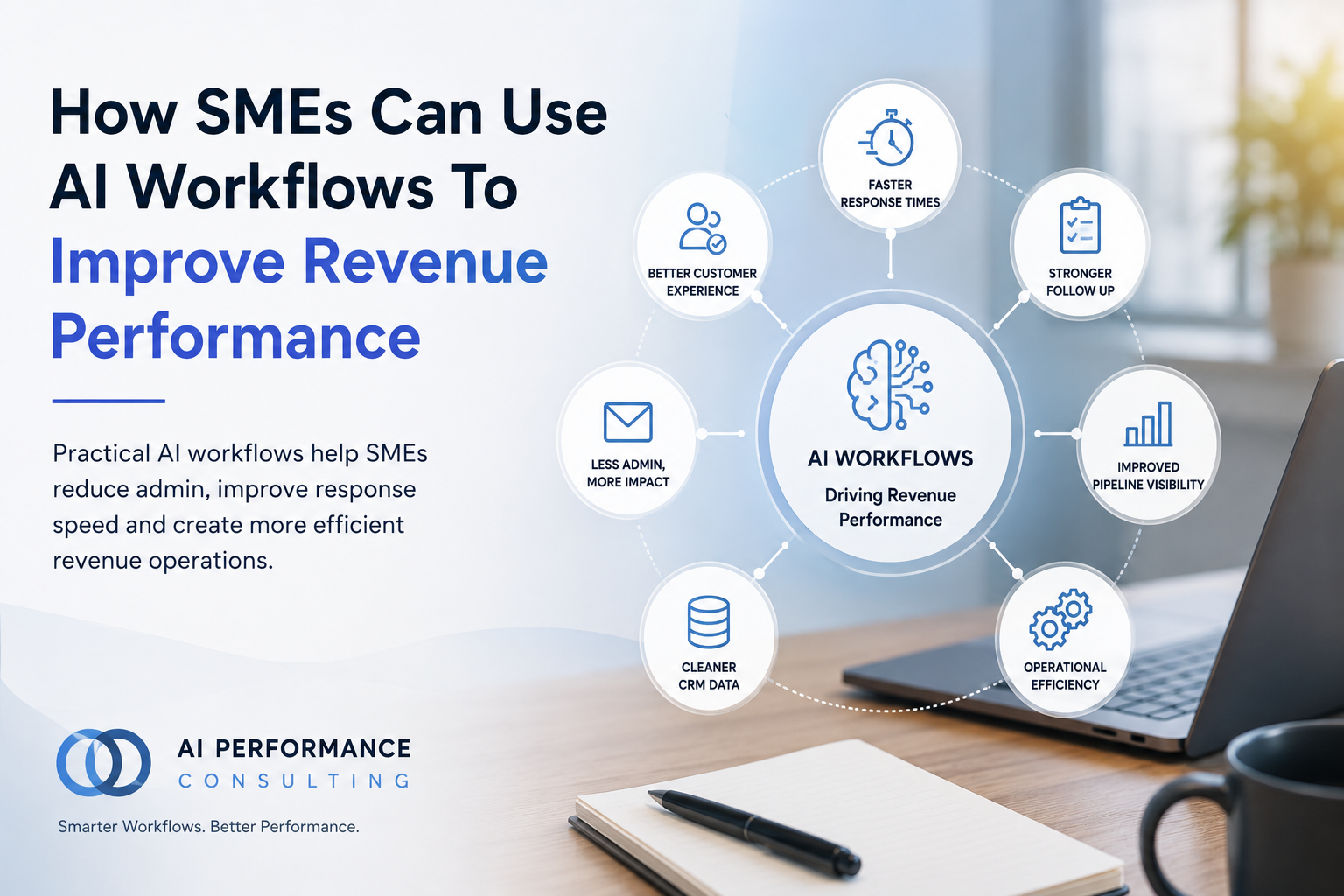
What Are AI Workflows?
AI workflows are structured operational processes where AI tools help businesses improve tasks such as lead handling, customer follow up, reporting, CRM updates, communication management and operational coordination.
Rather than replacing teams, practical AI workflows are typically designed to improve speed, consistency and operational efficiency across revenue generating activities.
Key Takeaways
Most SMEs do not need complex AI transformation projects
Practical AI workflows often improve speed and operational consistency
AI is most effective when attached to existing workflow problems
Revenue performance depends on marketing, sales and customer experience working together
SMEs should start with one workflow problem rather than large scale implementation
Where Do SMEs Usually Lose Time In Revenue Operations?
Many SMEs experience the same operational problems regardless of industry:
Leads sitting untouched for days
Inconsistent customer follow up
Sales notes not captured properly
CRM systems becoming outdated
Marketing and sales teams operating separately
Repetitive administrative work
Delayed proposal generation
Poor visibility across customer interactions
These issues often create hidden commercial costs that are difficult to measure directly. Slower response times can reduce conversion rates. Inconsistent follow up damages customer experience. Manual admin reduces the amount of time teams spend on higher value commercial activity.
Many SMEs across Milton Keynes and the wider UK are now exploring how AI workflows can improve operational performance without adding unnecessary software complexity.
According to research from McKinsey & Company, sales, marketing and customer operations are among the business functions most likely to benefit from workflow automation and generative AI productivity improvements.
What Does A Practical AI Workflow Look Like For SMEs?
For most SMEs, practical AI implementation is not about replacing teams. It is about improving workflow execution and reducing operational waste.
Examples include:
Automatic meeting summaries and action points
CRM data updates from calls or emails
Lead qualification assistance
Follow up reminders and task generation
Proposal drafting support
Customer communication summarisation
Marketing content support
Pipeline reporting automation
Internal workflow visibility
The value comes from improving operational consistency and reducing repetitive manual tasks that slow teams down.
Research from HubSpot State of AI Report has also shown that businesses are increasingly using AI to improve productivity, customer engagement and operational efficiency rather than purely experimental use cases.
At TWIBILL Intelligence, we have also explored how AI workflows are increasingly being used to support faster decision making, structured operational processes and more disciplined commercial execution.
Examples Of SME AI Workflow Improvements
Examples of practical AI workflow improvements include:
Automated lead routing
AI meeting summaries
CRM data updates
Proposal drafting assistance
Customer follow up reminders
Reporting automation
Marketing workflow coordination
Customer communication summarisation
For many SMEs, these types of operational improvements create measurable efficiency gains without requiring large scale transformation projects.
What Is The Revenue Performance Advantage Of AI Workflows?
One of the biggest misconceptions around AI is that the value comes purely from automation. In reality, the strongest operational gains often come from improving workflow quality and commercial discipline.
When implemented properly, practical AI systems can help businesses:
Improve response speed
Reduce manual admin
Improve customer follow up consistency
Strengthen CRM hygiene
Improve pipeline visibility
Reduce lead leakage
Improve coordination between marketing and sales
Increase operational efficiency
This creates a broader revenue performance effect across the business rather than simply improving one isolated task.
For SMEs, this matters because commercial performance is rarely driven by one department alone. Revenue performance is often the result of how effectively marketing, sales and customer interactions operate together across the customer lifecycle.
Why Should SMEs Start Small With AI?
Many businesses delay AI adoption because they assume implementation must involve large scale transformation projects. In practice, the opposite is often true.
The most successful implementations frequently begin with one workflow problem:
Slow lead follow up
Proposal delays
Manual reporting
CRM inconsistency
Customer communication overload
Starting small allows businesses to improve operational performance without disrupting existing processes or overwhelming teams.
According to Deloitte AI Institute, organisations that focus on practical operational use cases often see stronger early adoption and more measurable business outcomes.
Why AI Works Best When The Process Already Exists
AI does not fix broken operations automatically. It tends to amplify the quality of existing workflows.
Businesses with:
structured processes
clear ownership
defined customer journeys
disciplined CRM usage
operational consistency
are usually able to implement AI much more effectively.
Where workflows are unclear or fragmented, adding AI can sometimes increase confusion rather than reduce it.
For this reason, operational clarity should come before automation complexity.
Additional workflow and operational AI insights can also be found on TWIBILL Intelligence.
Summary
Practical AI workflows help SMEs improve operational efficiency, response speed, customer follow up and revenue performance. The strongest results usually come from improving existing workflows rather than implementing overly complex AI systems.
The businesses seeing the strongest results are often not the ones using the most advanced technology. They are the ones applying AI carefully to real operational bottlenecks and measurable workflow problems.
AI Performance Consulting helps SMEs identify workflow inefficiencies and implement practical AI systems that improve operational performance, customer responsiveness and revenue operations.
You can also explore additional operational AI and workflow thinking through TWIBILL Intelligence.
Frequently Asked Questions
What is an AI workflow?
An AI workflow is a structured operational process where AI tools support tasks such as customer follow up, reporting, CRM management, communication handling or workflow coordination.
How can SMEs use AI to improve performance?
SMEs can use AI to improve response speed, reduce manual admin, improve customer follow up consistency and create more efficient operational workflows.
Do SMEs need complex AI systems?
No. Most SMEs benefit more from improving one operational workflow at a time rather than attempting large scale AI transformation projects.
What business areas benefit most from AI workflows?
Sales, marketing, customer experience, reporting, CRM management and operational coordination are often among the areas that benefit most from practical AI workflows.
Can AI improve customer experience?
Yes. AI workflows can help businesses improve response speed, communication consistency and operational coordination across customer interactions.
What is revenue performance?
Revenue performance refers to how effectively a business converts operational activity into commercial outcomes across marketing, sales, customer experience and workflow execution.