
The Shift From AI Tools to AI Workflows: Why SMEs Need a New Approach to Performance
Published: June 2026
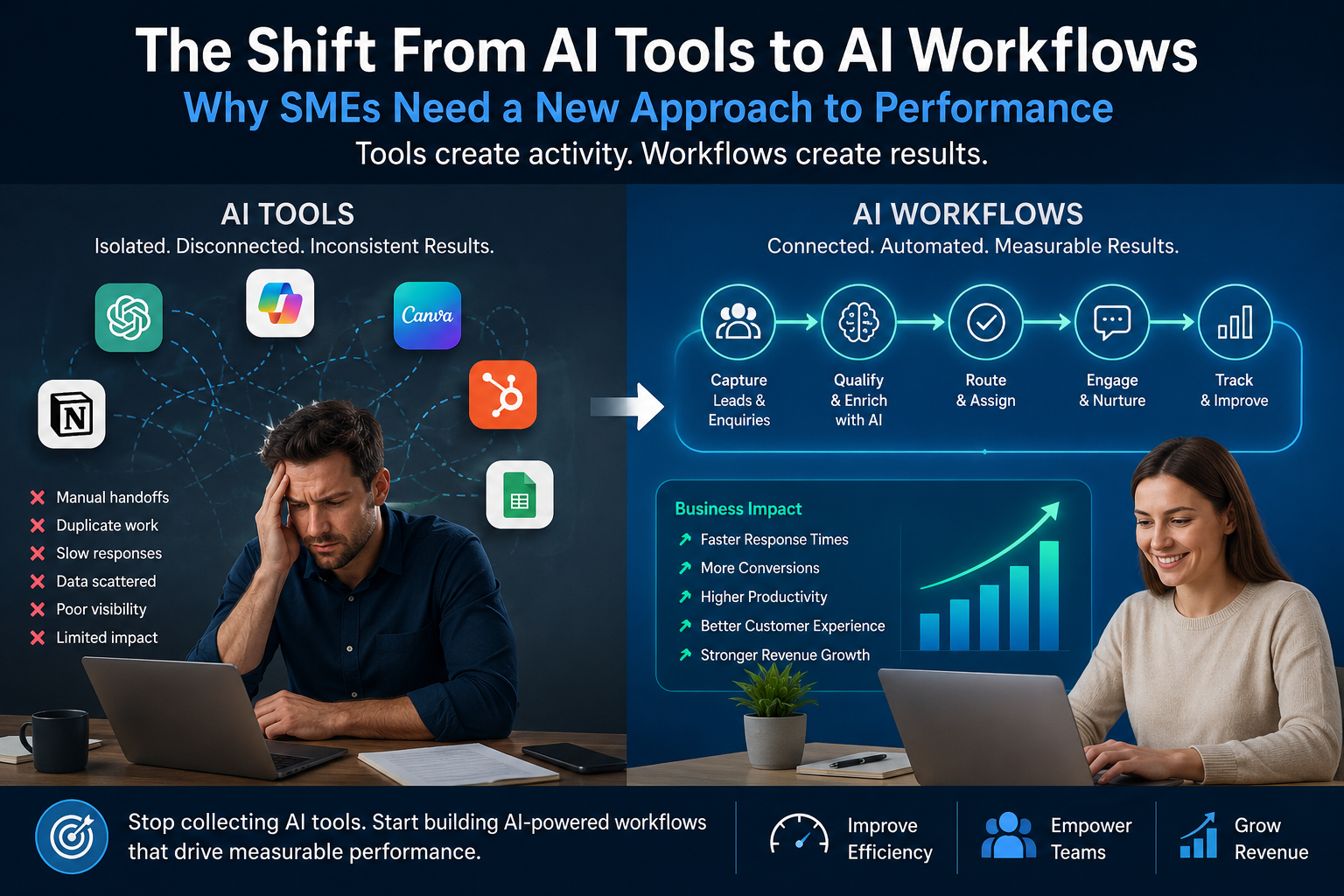
The Shift From AI Tools to AI Workflows: Why SMEs Need a New Approach to Performance
Over the past two years, AI adoption has accelerated rapidly across the SME market.
Business owners and teams have embraced tools such as ChatGPT, Microsoft Copilot, AI powered CRM systems, automation platforms, and a growing number of specialised AI applications. Access to AI is no longer the challenge it once was.
Yet despite widespread adoption, many businesses are asking a similar question:
Why are we using more AI tools but not seeing significantly better business performance?
The answer may be simpler than many organisations realise.
The next phase of AI adoption is not about adding more tools. It is about integrating AI into workflows that improve execution, responsiveness, efficiency, and commercial performance.
The businesses creating the greatest value from AI are increasingly focusing less on individual tools and more on how work moves through the organisation.
SMEs Have Adopted AI Faster Than They Have Improved Performance
Most SMEs can now access powerful AI capabilities at relatively low cost.
Content creation tools can draft articles in seconds. AI assistants can summarise meetings, answer questions, generate reports, and support day to day tasks. Automation platforms can connect systems and trigger actions across departments.
However, access alone does not guarantee results.
Many businesses find themselves in a situation where AI is being used regularly, but performance improvements remain difficult to measure. Teams experiment with different tools. Individuals develop their own ways of working. Isolated tasks become faster, yet broader business outcomes remain largely unchanged.
This creates a growing gap between AI adoption and AI performance.
Research from Gartner suggests that a significant proportion of AI initiatives may fail to deliver expected value because organisations struggle to connect technology investments to meaningful business outcomes.
The challenge is rarely the tool itself.
More often, it is how the tool fits into the workflow.
The Problem With Tool First Thinking
Many AI initiatives begin with a simple question:
“What AI tool should we use?”
While understandable, this often leads businesses down the wrong path.
A tool first approach frequently creates fragmented adoption. One team uses ChatGPT. Another adopts Copilot. Marketing experiments with content generation. Sales uses AI to draft emails. Operations explores automation.
Each activity may provide isolated benefits, but they often fail to create meaningful organisational performance gains.
This happens because businesses are optimising individual tasks rather than improving the workflow that connects them.
For example:
A sales team may use AI to write outreach emails faster, but if lead qualification remains inconsistent and follow up processes remain slow, overall sales performance may not improve.
A marketing team may generate content more efficiently, but if campaign execution, lead routing, and customer follow up remain fragmented, commercial outcomes may remain largely unchanged.
The issue is not the technology.
The issue is the workflow.
Why High Performing SMEs Focus on Workflows
Leading organisations are increasingly shifting their attention away from isolated AI tools and towards AI enabled workflows.
Microsoft has described AI agents as a mechanism for transforming entire workflows and business processes rather than simply improving individual tasks.
Similarly, Deloitte highlights how agentic AI is evolving towards workflow orchestration, where systems coordinate actions across multiple steps and business functions.
This represents an important shift in thinking.
Instead of asking:
“Which AI tool should we buy?”
Businesses are beginning to ask:
“Which business processes are slowing performance, and how can AI help improve them?”
This change in perspective often produces better results because it starts with performance objectives rather than technology.
Where AI Workflows Create Measurable Results
For most SMEs, the strongest opportunities are often found in workflows that directly influence execution speed, customer responsiveness, operational consistency, and revenue generation.
Lead Follow Up
Many businesses lose opportunities because responses are delayed or inconsistent. AI enabled workflows can help qualify enquiries, route leads, trigger follow up sequences, and improve response times.
CRM Administration
Sales teams frequently spend significant time updating records and managing data. Workflow automation can reduce manual administration and improve data quality.
Customer Communication
AI supported workflows can help manage recurring enquiries, provide faster responses, and ensure customers receive timely information.
Reporting and Insights
Operational and commercial reporting often involves manual data gathering and consolidation. AI can accelerate reporting workflows and improve visibility.
Marketing Execution
Content production, campaign coordination, lead nurturing, and performance reporting can all benefit from workflow based automation.
The common factor across these examples is not the technology itself.
It is the improvement of a business process that directly influences performance.
The Next Competitive Advantage
Many SMEs are currently competing on access to tools.
Over time, that advantage will disappear.
AI capabilities are becoming increasingly accessible and embedded into existing software platforms. What is rare today will become standard tomorrow.
The more durable competitive advantage is likely to come from how effectively businesses redesign workflows around the combined strengths of people and AI.
McKinsey argues that the future of work is likely to be defined by partnerships between humans, AI systems, and automation rather than complete replacement.
For SMEs, this means the goal should not be replacing people.
The goal should be improving execution.
Businesses that integrate AI into high value workflows will often achieve faster response times, more consistent customer experiences, stronger operational efficiency, and better commercial performance.
Conclusion
The first wave of AI adoption was largely tool driven.
The next wave is becoming workflow driven.
The businesses seeing the strongest results are not necessarily using the most AI tools. They are identifying where performance is being constrained, redesigning workflows around those bottlenecks, and using AI to improve how work actually gets done.
As AI capabilities continue to evolve, the key question for SMEs is becoming less about technology and more about execution.
Not:
“Which AI tool should we use next?”
But:
“Which workflow is limiting our performance today, and how can AI help improve it?”
That shift may prove to be the difference between AI experimentation and measurable business performance.
Frequently Asked Questions
What is an AI workflow?
An AI workflow combines AI tools, automation, systems, and people into a structured process designed to achieve a business outcome more efficiently.
Why are AI tools not improving performance?
Many organisations use AI tools in isolation. Without integration into broader workflows, improvements often remain limited to individual tasks rather than overall business performance.
What is the difference between an AI tool and an AI workflow?
An AI tool performs a specific task. An AI workflow connects multiple activities, systems, and people together to improve an end to end business process.
Where should SMEs start with AI automation?
The strongest starting points are often workflows that involve repetitive activity, delays, manual coordination, customer communication, lead management, or reporting.
What business functions benefit most from AI workflows?
Sales, marketing, customer service, reporting, operations, and administrative processes are often among the earliest areas where SMEs see measurable benefits.